
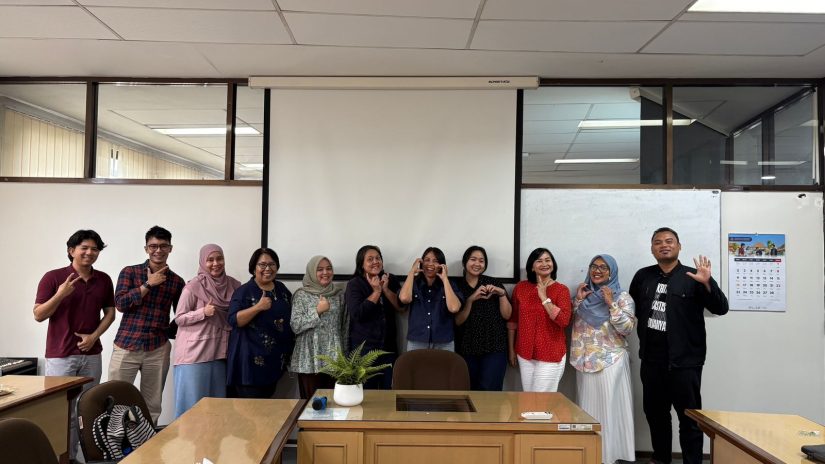
The Doctoral Program in Media and Cultural Studies (KBM), Graduate School, Universitas Gadjah Mada once again held the KBM PhD Colloquium Period 1 on Friday, 13 February 2026, at Meeting Room A, 5th Floor, UGM Graduate School. The event, which took place from 10:00 a.m. to 4:00 p.m. (WIB), served as a space for academic dialectics for the 2022 and 2023 cohorts to examine and refine their dissertation research proposals. This forum was facilitated by the KBM Doctoral Program as a discussion space for PhD students seeking feedback from their peers to support the progress of their dissertation writing. On this occasion, four topics were presented, ranging from app-based halal dating practices, the representation of history in dioramas, the trajectory of popular characters in transmediation, to the performativity of drag queens in heteronormative spaces.
The first presentation addressed the theme of Halal Dating Practices among Users of the TOI Platform. This research examines how a Muslim-based dating application shapes, constrains, and at the same time provides space for user agency in building intimate relationships claimed to be “halal.” The discussion developed around the construction of the meaning of “halal,” power relations between users and the platform, as well as aspects of gender, economic class, and commodification through premium features. The colloquium also emphasized the importance of situating this phenomenon within the broader context of the mediatization of religiosity and the strengthening hijrah trend over the past decade. During the discussion session, the Head of the KBM Doctoral Program, Ratna Noviani, S.I.P., M.Si., Ph.D., underscored the importance of conceptual sharpness in analyzing this phenomenon. “Phenomena such as halal dating cannot be read merely as technological trends, but as cultural practices that produce meanings, identities, and even new forms of religiosity. This is where strong problematization and a consistent theoretical framework become crucial.”
The second topic discussed the representation of history through a reading of the Diorama Arsip Jogja using Stuart Hall’s theory of representation. The discussion emphasized that from a constructionist perspective, history never appears as neutral, but is always produced through systems of signs and representational practices. The colloquium encouraged further clarification of the methodological position—whether through a semiotic or discursive approach—as well as strengthening the critical dimension in examining potential historical biases that may emerge within the visual medium.
The third presentation highlighted the transformation of the character Si Juki across various media, including film. The discussion focused on shifts in narrative and character identity within the process of transmediation. Participants suggested possible analytical lenses such as cosmopolitanism, local masculinity, and intermediality, with particular attention to changes in conflict and social context accompanying the character’s adaptation.
The final topic explored the performativity of drag queens in the context of the Raminten Cabaret Show in Yogyakarta. Drawing on theories of performativity and intersectionality, the research examines how gender identity is constructed, negotiated, and enacted within a socially heteronormative space. The discussion highlighted a possible ambivalence: whether drag practices function as subversive acts against dominant norms or instead operate as strategies of negotiation to secure safe spaces and economic access. Local context and cultural strategies were identified as crucial aspects requiring deeper analysis.
The KBM PhD Colloquium Period 1 demonstrated reflective and constructive intellectual dynamics. Each presenter received substantive feedback concerning the sharpness of their research questions, theoretical consistency, and methodological relevance. Through this forum, the Doctoral Program in Media and Cultural Studies reaffirmed its commitment to fostering an academic tradition that is critical, dialogical, and responsive to contemporary socio-cultural dynamics.
Contributor: Averoes Fitria Maryam