
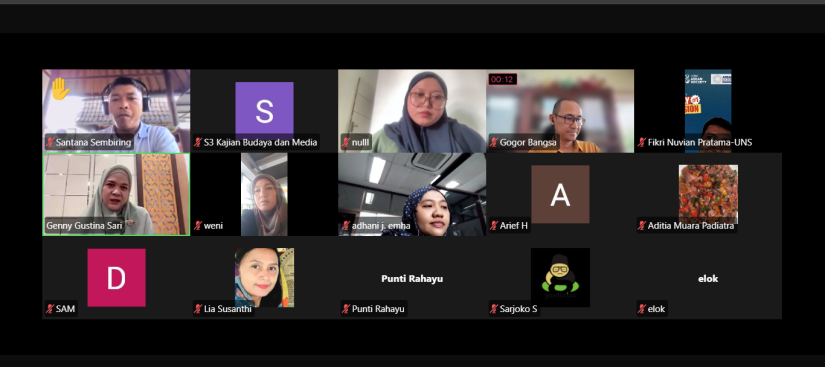
The Cultural and Media Studies (KBM) Doctoral Program successfully held its Doctoral Research Day, a two-day virtual forum taking place from Wednesday to Thursday, June 3–4, 2026. On the first day, the event featured two KBM doctoral alumnae, Dr. Genny Gustina Sari and Dr. Kusnul Fitria, as keynote speakers. Centered around the theme “Negotiating Masculinity within the Landscape of Popular Culture,” the discussion was moderated by Dr. Petrus Gogor Bangsa.

In the first session, Dr. Genny discussed her dissertation research titled “Sexuality and Subordinate Masculinity in the Films ‘Test Pack’ (2012) and ‘Seperti Dendam, Rindu Harus Dibayar Tuntas’ (2021)”. In her presentation, she explained that the phallus is not merely a biological organ but also functions as a symbol of power. Through her research, Dr. Genny analyzed how subordinate masculinity in relation to sexual discourse is represented, along with its underlying socio-political contexts.
Based on her observations of both films, the societal pressure to be “manly” poses a distinct burden on men. Dr. Genny also highlighted the shifting representation of masculinity in Indonesia across different eras:
-
The New Order Era: Ideal masculinity was strictly identified with economic stability and perceived sexual prowess.
-
The Reformation Period: The representation shifted toward men becoming more involved in domestic and household affairs.
Nevertheless, despite these shifting values, male infertility and impotence are still marginalized and treated as “the other” within the politics of masculinity.

The second presentation was delivered by Dr. Kusnul Fitria, sharing her research titled “From Fan to Idol: Self-Representation and the Negotiation of Masculinity among K-Pop Fanboy Micro-Celebrities on Instagram”. Dr. Kusnul presented findings from her digital ethnography study conducted on four Instagram accounts of Indonesian K-Pop fanboy micro-celebrities.
She revealed that men who enjoy K-Pop culture are frequently subjected to negative stigma, often being associated with homosexuality or viewed as lacking traditional masculinity. These fanboys typically engage in various fan activities, such as posting delusional edits with their favorite idols, attending concerts, purchasing merchandise (like lightsticks), and adopting Korean fashion styles. To counteract the “unmasculine” label, these fanboys engage in identity negotiation. They counterbalance their K-Pop hobby by showcasing activities traditionally perceived as masculine by society, such as playing soccer.
Both studies yielded a remarkably similar conclusion: neither the male characters depicted in the films nor the fanboys on social media engage in overt or structural resistance against the stigma and marginalization they face. Instead of launching an open rebellion, they choose negotiation as a strategy to maintain social acceptance within their respective environments.
If one is interested in watching the record, please check KBM’s YouTube channel through this link https://www.youtube.com/watch?v=6eAKWPoycIM
Contributor: Adhani J. Emha