
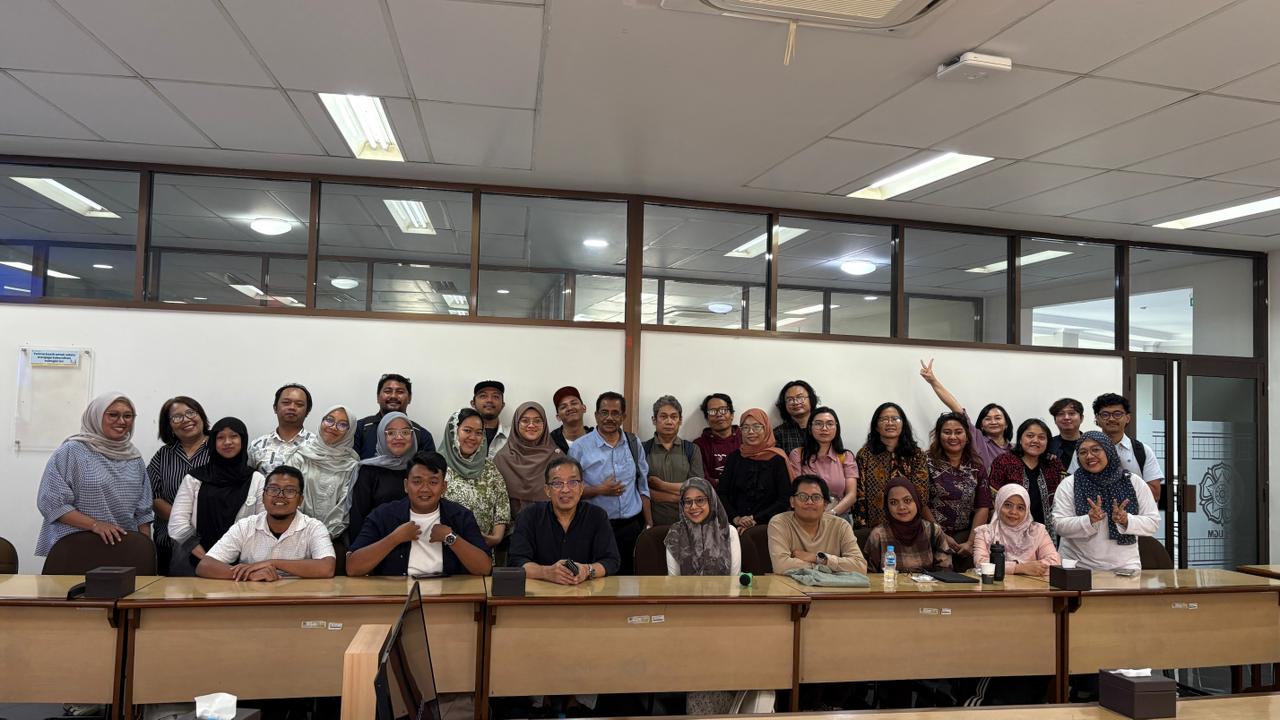
On Friday (8/5), the Media and Cultural Studies Program (KBM) at Universitas Gadjah Mada organized a discussion series featuring Johanes Suryatmoko, commonly known as Romo Moko, as the speaker. The public lecture, titled “Gilles Deleuze and Creativity in Art,” took place at Meeting Room A on the 5th Floor of the Graduate School Building at UGM and was attended by KBM students as well as members of the public interested in the thought of Gilles Deleuze.
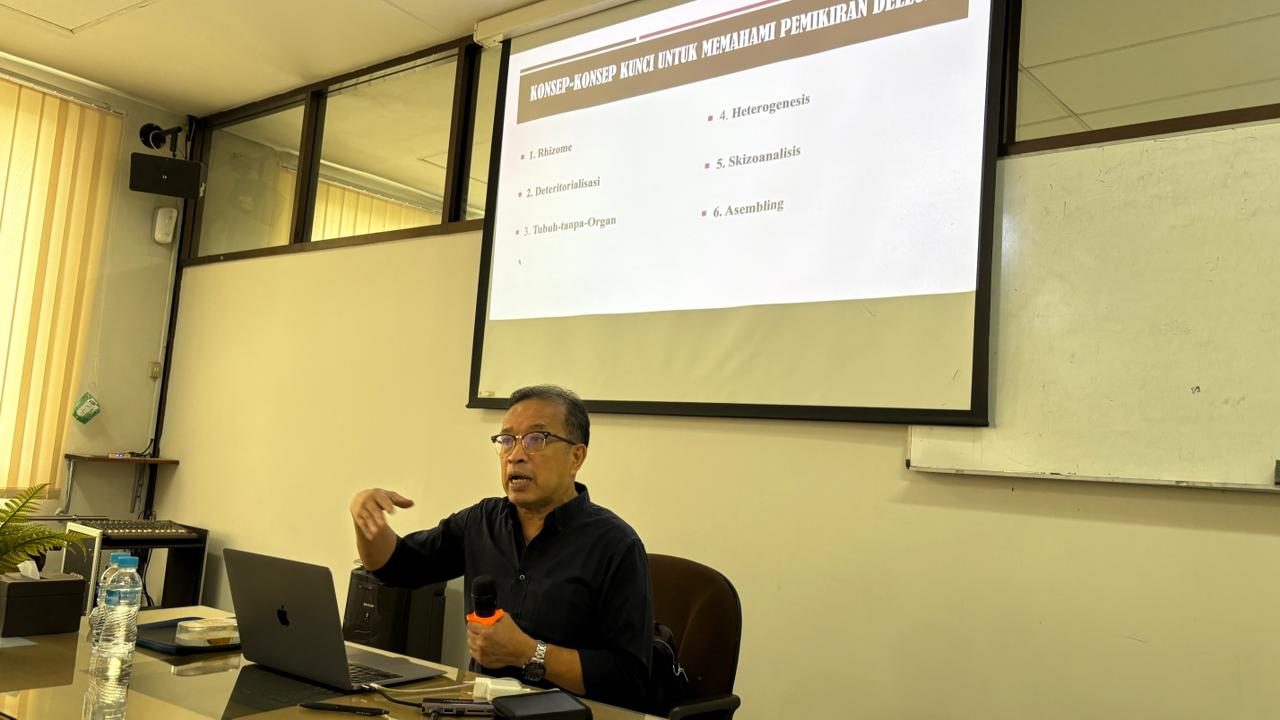
In his presentation, Romo Moko explained Deleuze’s concept of the rhizome, a concept inspired by root systems that grow horizontally without a central point or hierarchy. When applied to the world of art, the rhizome allows creativity to emerge through the formation of new connections—not by creating something entirely from nothing, but by linking elements that were previously disconnected. The rhizome also breaks down disciplinary boundaries by encouraging intersections between art and technology, art and activism, as well as art and spirituality.
According to Romo Moko, the concept of the rhizome opens space for collectivity because creativity is no longer understood solely as an individual process, but rather as a form of distributed intelligence. In this sense, collective creativity becomes an important aspect of artistic production.
After discussing the concept of the rhizome, Romo Moko continued with an explanation of Deleuze’s concept of deterritorialization, which he described as a “machine.” Deterritorialization refers to the process through which elements of a system are detached from their original context, structure, or “territory,” allowing them to acquire new meanings in different contexts. In the realm of art, Romo Moko explained, deterritorialization marks a shift in focus from interpretation to affect.
He further elaborated that deterritorialization as a machine can be understood through forms of connection that generate new functions and meanings. For example, a bicycle can become an art object when placed in a gallery, while the human body can become part of an artistic machine when connected to painting tools. Within the rhizomatic perspective, the artist is no longer seen merely as a creator, but as a connector who builds new relationships and associations. In addition to discussing the concepts of the rhizome and deterritorialization, Romo Moko also briefly introduced the concepts of heterogenesis and schizoanalysis within Deleuze’s thought, despite the limited time available.
Through this discussion series, participants were expected to gain a deeper understanding of Deleuze’s major concepts and their relevance to contemporary artistic practices.
Contributor: Adhani J. Emha